
Google has officially introduced Search Generative AI performance reports inside Search Console. If you run a website and your content has been showing up in AI Overviews or AI Mode, you can now see data on that, at least some of it.
This is a meaningful step forward for website owners and SEO professionals. But there’s a catch for the Google Search Console AI performance report and it’s a significant one.
Let me break down what this update actually means, what data you’re getting and what Google is still keeping to itself.
What Is the Search Generative AI Performance Report?
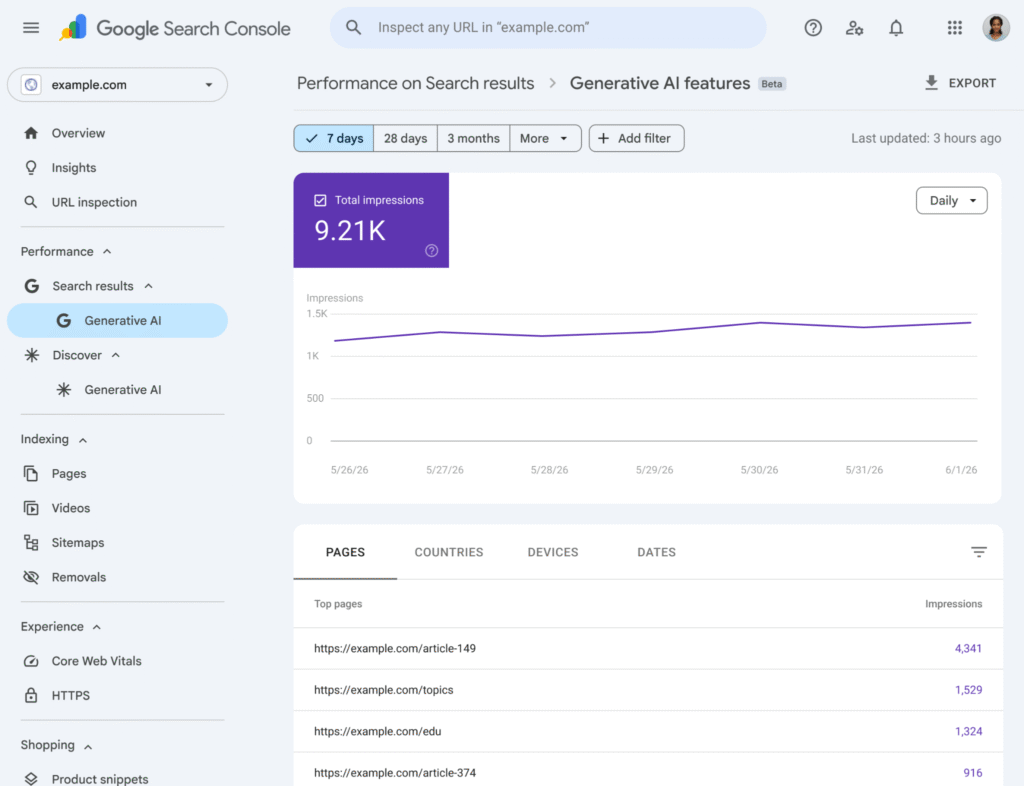
The new report lives inside Google Search Console and tracks how your pages perform within Google’s generative AI features, specifically AI Overviews and AI Mode. These are the AI-generated answer blocks that appear at the top of Google Search results for many queries.
Until now, if your content was being cited inside an AI Overview, you had no official visibility into that. You could see impressions and clicks from traditional organic results but the AI layer was a black box. This report is Google’s first step toward opening that box.
The report currently includes five data dimensions:
- Impressions: How many times your URLs appeared inside generative AI features in Search and Discover.
- Pages: Which specific URLs of your site were referenced within AI features.
- Countries: Where in the world your site is appearing in AI-powered results.
- Devices: The device types people were using when they saw your site within AI results (available for Search, not Discover).
- Dates: A performance timeline with hourly, daily, weekly and monthly views.
This gives you a clearer picture of your AI visibility footprint. If you’ve been wondering whether Google’s AI is actually pulling from your content, this report will tell you.
Generative AI Performance Report’s The Big Problem: No Click Data
Here’s the part that will frustrate publishers and SEOs.
The report does not include click data. You can see how often your pages appear inside AI responses but you cannot see how many people actually clicked through to your site from those responses.
That gap matters. The entire reason website owners care about appearing in AI Overviews is whether it translates to actual traffic. Impressions without clicks is only half the story. Without click-through data, it’s nearly impossible to calculate the real business value of your AI visibility.
When asked about this, a Google spokesperson said they are “continuing to work with website owners to understand what insights will be most helpful” and will introduce more metrics over time. That’s a reasonable answer but it doesn’t solve the immediate problem.
For now, treat the impression data as a reach metric, not a revenue metric. It tells you whether Google is finding your content credible enough to cite (which is useful signal) but it won’t tell you whether that citation is driving meaningful traffic.
The Second Feature: Blocking Your Content from AI Responses
Alongside the performance report, Google is also testing a content blocking control directly inside Search Console. This is a toggle that would allow website owners to opt their content out of appearing in AI Mode and AI Overviews.
This is a notable development. Up until now, your main option for controlling AI crawling was through your robots.txt file, a technical approach that required developer access. A Search Console toggle would put that control in the hands of content and marketing teams without needing to touch server configuration.
Google is still in the testing phase with this feature, so it hasn’t rolled out broadly. But the intent is clear: they’re building the infrastructure for publishers to have more say over how their content is used in AI-generated answers.
Who Can Access These Google Search Console Generative AI Report Features Right Now?
Both the performance report and the blocking controls are in early rollout. Google is starting with a subset of website owners in the United Kingdom before expanding globally.
If you’re based in the UK and have Search Console access to your property, check your dashboard now. If you’re outside the UK, you’ll need to wait for a broader rollout. Google hasn’t committed to a specific timeline for global availability.
What This Means for Your SEO Strategy
A few practical takeaways from this announcement:
Impression data is still worth tracking
Even without click data, knowing which pages Google’s AI is pulling from tells you something important: that content is being treated as authoritative. High impressions in AI features are a signal worth optimizing toward.
The blocking control gives you leverage
If you’re in a niche where AI Overviews are summarizing your content without driving traffic back to you, the ability to opt out gives you a negotiating chip. Whether opting out makes sense depends on your specific traffic model and industry.
More metrics are coming
Google’s spokesperson confirmed additional metrics are on the roadmap. Click data is the obvious next addition and the industry pressure to include it is strong. Keep an eye on Search Console updates over the next few months.
The AI search landscape is still maturing
By this report, Google is acknowledging that website owners deserve visibility into how their content fuels AI responses. It’s a start but not the complete picture yet.
Final Thoughts
Google’s introduction of Search Generative AI performance reports is a step in the right direction. For the first time, you have official, first-party data on how your site performs within AI search features. That’s genuinely useful.
The absence of click data is the biggest limitation right now and it’s the piece that publishers most need to make informed decisions. Google knows this, which is why they’ve already signaled that more metrics are coming.
If you have access to the report, start exploring your impression data today. Note which pages are appearing in AI results and cross-reference them with your traditional Search Console performance data. Understanding where your AI visibility overlaps or diverges from your organic traffic will become increasingly important as AI Mode expands.
The rules of search visibility are changing. This report is Google’s first attempt to give website owners visibility into the new search landscape.