
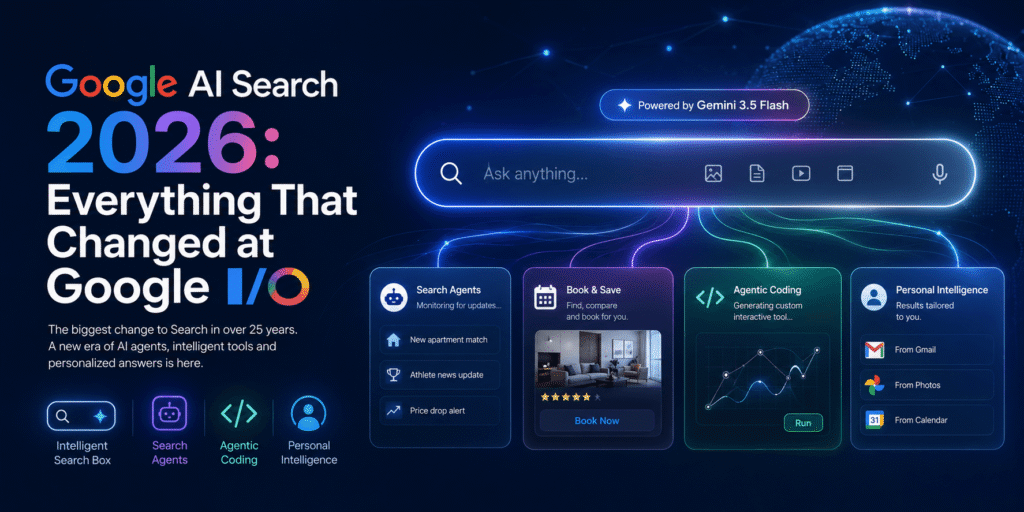
Google just made the biggest change to Search in over 25 years. And if you use the internet to find information, research products or run a business, this update affects you directly.
At Google I/O 2026, Google didn’t just tweak its search results page. It rebuilt the entire concept of what Search is supposed to do. The shift from a keyword box to a full-blown AI agent system is real and it’s already rolling out globally.
This post breaks down every major announcement so you understand what changed, why it matters and what to expect next.
What Is Google AI Search 2026 and Why Does It Matter?
Google AI Search 2026 refers to the collection of AI-powered features Google announced at its annual I/O developer conference on May 19, 2026. The centerpiece is the upgraded AI Mode, which now runs on Gemini 3.5 Flash as the default model for all users globally.
But the changes go far beyond a model upgrade. Google introduced search agents, a redesigned search box, agentic coding capabilities and expanded Personal Intelligence features. Together, these additions mark the end of keyword-based searching as the default experience.
The numbers behind this shift are hard to ignore. AI Mode hit one billion monthly users just one year after its debut. Queries have more than doubled every quarter since launch. Last quarter saw search queries reach an all-time high. People are not just tolerating AI in Search. They are actively using it more than ever before.
The New Intelligent Search Box
The search box itself got its first major redesign in over two decades. Google rebuilt it from scratch with AI at the center.
The new box dynamically expands as you type, giving you room to describe what you actually need instead of compressing your question into a few keywords. It offers AI-powered suggestions that go beyond autocomplete. These suggestions are designed to help you formulate your question more precisely, not just finish the word you started typing.
More importantly, it now accepts multiple input types. You can search using text, images, files, videos or Chrome tabs. If you want to find something based on a screenshot you took or a document you have open, you can now feed that directly into Search.
This change matters because most people have always searched in language that felt unnatural. Short keyword strings were a compromise forced by the limitations of the old system. The new search box removes that constraint.
Google Search Agents: The Biggest Shift
Search agents are the most significant announcement from I/O 2026. Google is entering what it calls the era of Search agents, where you can create, customize and manage AI agents directly inside Search.
The first type is the information agent. These agents run in the background around the clock, scanning the web for updates related to your specific question or task. They monitor blogs, news sites, social posts and real-time data feeds covering finance, shopping and sports. When something relevant changes, the agent sends you a synthesized update.
The practical applications are wide-ranging. If you are apartment hunting, you can describe your exact requirements and your agent will continuously scan listings and alert you when something matches. If you follow a specific athlete or brand, your agent will notify you the moment relevant news drops.
Information agents will launch first for Google AI Pro and Ultra subscribers in the summer of 2026.
Google is also expanding agentic booking capabilities. You can describe specific criteria for a service or experience and Search will pull together pricing, availability and direct booking links. For categories like home repair, beauty or pet care, Google can even call businesses on your behalf. These features will roll out to US users this summer.
Agentic Coding in Search
This is the feature that most directly changes how Search responds to complex questions.
Google integrated its Antigravity coding capabilities and Gemini 3.5 Flash into Search so that results can now include custom-built interactive tools generated in real time. If your question is better answered with a visual simulation, an interactive graph or a dynamic layout, Search builds it for you on the fly.
This means Search does not just return links or text summaries. It can construct the ideal format for your specific question. Trying to understand astrophysics? Search can build a visual model. Want to see how a mechanical watch works? Search can generate an interactive diagram.
For ongoing tasks like planning a wedding or tracking a home renovation, Search can build custom dashboards and mini apps you can return to over time. These are not static pages. They are persistent tools tailored to your specific project.
Custom mini app building will be available for Google AI Pro and Ultra subscribers in the US first and will expand from there.
Expanded Personal Intelligence
Personal Intelligence is Google’s approach to making Search context-aware beyond just knowing what you typed.
By connecting apps like Gmail and Google Photos to Search, you give it access to your personal context. This means Search can answer questions that require understanding your situation, not just the world’s general information.
Personal Intelligence was previously limited in availability. Google has now expanded it to nearly 200 countries and territories across 98 languages with no subscription required. You stay in control of what you connect and when.
Google Calendar integration is also coming soon, which will allow Search to factor in your schedule when answering time-sensitive questions.
What This Means for Content Creators and Marketers
If you create content or manage a brand’s digital presence, these changes are worth paying close attention to.
Search agents that monitor the web continuously will surface content based on relevance to ongoing tasks, not just individual queries. This shifts the emphasis further toward content that is genuinely useful over time rather than content optimized purely for a single search moment.
The expanded Personal Intelligence features mean that Search results can now be filtered through a user’s personal context. Generic content that does not connect to a specific need may get deprioritized in favor of results that match the user’s situation more precisely.
The custom UI and mini app capabilities also signal that the search results page itself will become more dynamic. As Search builds interactive tools on the fly, the traditional ten blue links model becomes less central to how people get answers.
The core principle for content creators remains the same. Create content that solves real problems for real people. These updates reward depth and relevance more than ever before.
Key Takeaways From Google AI Search 2026
Google Search has moved from a lookup tool to an active assistant that works on your behalf. The intelligent search box lowers the barrier to asking better questions. Search agents remove the need to check constantly for updates. Agentic coding turns Search into a tool builder. Personal Intelligence makes results relevant to your life specifically.
These changes are rolling out now. Some features are available today globally. Others are arriving for subscribers this summer. Either way, the direction is clear.
Search is no longer about finding information. It is about having an AI system that finds, monitors and acts on information for you.
If you want to understand how these shifts affect your content strategy or SEO approach, get in touch. I work with businesses navigating exactly this kind of change.